
Budapest: Historic Beauty Meets GPS Treasure Hunts
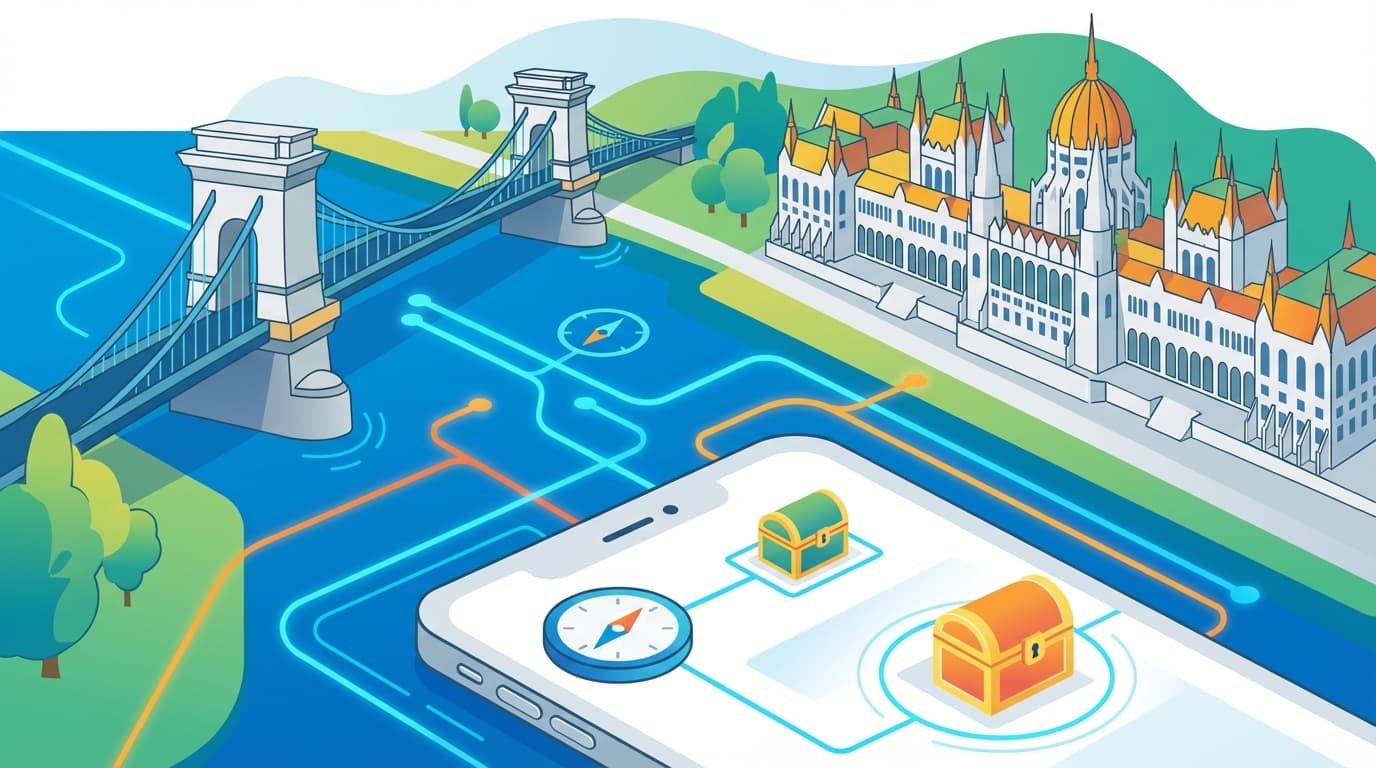
Stand on the Buda hills at dusk and watch the Parliament Building catch fire in golden light across the Danube. It's the kind of view that stops conversations mid-sentence. Budapest does this constantly — ambushes you with beauty when you're just trying to cross a bridge or find a coffee shop. Split by the river into hilly, castle-crowned Buda and flat, boulevard-lined Pest, the Hungarian capital layers Roman ruins beneath Ottoman domes beneath Gothic Revival spires beneath Art Nouveau palaces. It's a living museum, yes. But it's also, increasingly, a giant walkable game board. As of 2026, Budapest has become one of Europe's premier destinations for immersive GPS treasure hunts and team-building adventures — activities that turn its streets, thermal baths, and hidden corners into something you don't just admire but actively explore.
The numbers back this up. According to Hungary Today, Hungary's tourism sector surpassed 20 million total guests for the first time in 2025, with Budapest accounting for 60% of all foreign tourist nights. According to Budapest Info, the city welcomed approximately 6 million foreign visitors in 2024 alone — a 24% increase year-over-year. People aren't just coming to gaze at the Parliament Building anymore. They're coming to play.
A City Built Like a Game Board: Budapest's Unique Layout
Budapest's geography practically begs for exploration-based games. The Danube cleaves the city into two distinct halves — Buda on the west bank, Pest on the east — each with its own character, terrain, and concentration of landmarks. Think of it as a dual-zone game structure: teams cross between worlds, navigating from the medieval Castle District to the bustling ruin bars of the Jewish Quarter, shifting centuries and atmospheres with every bridge crossing.
What makes this work so well is density. In District V (the heart of Pest) and District I (the Buda Castle area), teams participating in GPS city games can hit 10 to 15 major sights in a two-hour walking route without exhaustion, according to Treasure Hunt Budapest. That walkability matters enormously. Unlike sprawling capitals where you need a car or spend half your time underground on the metro, Budapest's historic core is compact enough to cover on foot — yet varied enough to sustain hours of puzzle-solving and discovery.
Then there's the Millennium Underground (M1), the oldest metro line in continental Europe, which opened in 1896. Running beneath Andrássy Avenue, it connects key landmarks from the city center to City Park in minutes, adding an underground transit layer that city exploration games can weave into their routes.
Architecture and History: A Living Movie Set
Walk five blocks in Budapest and you'll pass through two thousand years of architectural history. Roman foundations give way to Ottoman bath houses, which sit alongside Baroque churches, Neo-Gothic monuments, and Secessionist apartment buildings dripping with ceramic ornament. Among Central European capitals, this kind of stylistic range is unmatched. For scavenger hunts and GPS-based city games, it means every street corner can serve as a clue or waypoint — and there's always something worth looking at while you figure out the next puzzle.
The "96 Rule" — A Perfect Trivia Challenge
Here's one of Budapest's most satisfying architectural secrets. According to the Lufthansa Travel Guide, no building in the city center stands taller than 96 meters — a deliberate reference to 896 AD, the year the Magyar tribes settled in the Carpathian Basin. Both St. Stephen's Basilica and the Hungarian Parliament Building hit exactly this height, symbolizing the equality of church and state. This is the kind of layered historical detail that makes Budapest ideal for gamified exploration. The city rewards people who look closely and think critically.
UNESCO World Heritage Protection
According to the UNESCO World Heritage Centre, the Banks of the Danube, the Buda Castle Quarter, and Andrássy Avenue are all protected World Heritage zones. These areas happen to be pedestrian-friendly and packed with landmarks — perfect for scavenger hunt waypoints that require no vehicle transport. Walking along the Danube promenade, teams pass the neo-Gothic Parliament, the Chain Bridge, and the poignant Shoes on the Danube Bank memorial. Each one becomes a potential puzzle stop in a well-designed city game.
Hidden Underground Worlds
Budapest's history doesn't stop at street level. The Buda Castle Labyrinth and the Hospital in the Rock — a secret World War II and Cold War-era hospital and nuclear bunker carved into the hill beneath the Castle District — open up underground exploration that adds a genuine thriller element to adventure itineraries. These sites work especially well for spy-themed or historical mystery games, where teams piece together narratives from Budapest's turbulent 20th-century past.
The Danube: Europe's Most Dramatic Urban Waterfront
The Danube isn't just a geographical feature in Budapest. It's the city's spine, its mirror, its most photogenic asset. The panoramic views from both banks — from the Buda hills looking across to the illuminated Parliament, or from the Pest embankment gazing up at the Fisherman's Bastion — rank among the most celebrated urban vistas anywhere in Europe.
For team adventures, the river works as both boundary and connector. GPS treasure hunt routes frequently use bridge crossings as pivotal moments in the game narrative, requiring teams to shift from one side of the city to the other. The Chain Bridge, Liberty Bridge, and Margaret Bridge each offer distinct views and atmospheres. A simple river crossing becomes a memorable chapter in the experience.
There's a practical advantage too. Event planners have noted that Budapest offers "high-value" team building, with activities like private boat regattas on the Danube costing significantly less than equivalent experiences in Western European capitals like Vienna or Paris, according to Treasure Hunt Budapest.
Thermal Baths: The Ultimate Post-Game Reward
Budapest holds a distinction no other capital city can claim: it sits on thermal waters with healing qualities. According to Budapest Thermal Baths, the city boasts 123 natural thermal springs and over 100 thermal baths, including the largest medicinal bath in Europe. This is why Budapest has long carried the title "City of Spas."
Read also: QR Codes for Geocaching and Treasure Hunts: The Simplest Path Without Special Apps
These baths aren't museum pieces. They're active social hubs and, more and more often, the relaxing finale for corporate team-building events. After hours of puzzle-solving and city exploration, few rewards beat sinking into centuries-old thermal waters.
Széchenyi Thermal Bath
Set in City Park, the Széchenyi Thermal Bath features 18 pools within stunning Neo-Baroque architecture. It's the largest medicinal bath in Europe and a common final destination for GPS routes winding through the City Park area. Its bright yellow façade and outdoor pools — steam curling off the water into cool air — have become one of Budapest's most iconic images.
Rudas Bath
Built in the 16th century during the Ottoman occupation, Rudas Bath still has its original octagonal Turkish pool beneath a domed ceiling — a direct architectural link to Budapest's 150 years under Ottoman rule. A modern rooftop hot tub offers panoramic views of the Danube and the city skyline. It's a premium spot for team debriefs and post-adventure unwinding.
Gellért Bath
The Gellért Bath is famous for its Art Nouveau interior, stained glass windows, and intricate mosaics. People often describe it as "bathing in a cathedral," and they're not wrong. It represents the pinnacle of Budapest's early 20th-century thermal bath culture and provides a suitably grand setting for wrapping up a day spent exploring the city.
GPS Treasure Hunts: How Budapest Became a Gamified City
Budapest has built a mature market for gamified sightseeing. The ingredients were already there: walkability, architectural density, and what you might call a "hidden gem culture" — the city's abundance of tucked-away courtyards, secret passages, and overlooked details that reward the genuinely curious.
Smartphone-Based City Games
Companies like Quest with Us and World City Trail offer smartphone-based apps where teams solve riddles to unlock the next GPS coordinate, according to Quest with Us. These games weave historical trivia into navigational challenges, asking participants to observe architectural details, decode inscriptions, and piece together clues leading through the city's most significant landmarks.
What sets these apart from traditional guided tours? Freedom. Reviews for Budapest scavenger hunts consistently highlight the ability to explore at your own pace. According to user reviews on platforms like TripAdvisor and GetYourGuide, these activities receive ratings of 4.5 out of 5 stars or higher for both families and corporate groups, with participants specifically praising the balance of learning history versus solving puzzles.
The Kolodko Phenomenon: Budapest's Real-Life Treasure Hunt
One of Budapest's most distinctive trends as of 2025-2026 is the hunt for the Kolodko miniature statues. According to Budapest Flow, sculptor Mihály Kolodko has hidden over 30 tiny guerrilla bronze statues across the city — a miniature diver perched on a railing, a murdered squirrel tucked into a wall, dozens of other whimsical figures placed on fences, lamp posts, and building facades.
Finding them has become a dedicated treasure hunt for tourists and locals alike. Budapest residents widely regard the Kolodko statues as a brilliant way to decentralize tourism, drawing visitors away from the crowded Parliament area to quieter streets in search of tiny art pieces. For casual groups and families, the hunt forces participants to look closely at the city's details — exactly the kind of attentive observation that makes any city exploration game rewarding.
AR and VR Integration
Technology is adding new dimensions to Budapest's adventure scene as of 2026. Augmented reality (AR) apps let players point their phones at ruins and see them digitally "rebuilt" to their former glory, according to Treasure Hunt Budapest. On the indoor side, VR Park Budapest, described as Hungary's largest VR center, offers team adventures that complement outdoor GPS hunts — especially useful during bad weather or for groups craving high-tech experiences.
Ruin Bars as "Safe Houses"
Budapest's famous ruin bars — those eclectic drinking spots built in the crumbling courtyards of the Jewish Quarter — make natural pit stops or thematic "safe houses" in spy-themed games. They add atmosphere and a welcome refreshment break to walking routes, blending the city's nightlife culture with its adventure tourism scene.
Team Building in Budapest: Why Corporate Groups Are Choosing the Hungarian Capital
Budapest has risen to top-tier status for corporate team building, and the reasons are straightforward: cultural depth, affordability, and creative activity options that few European cities can match.
According to Treasure Hunt Budapest, new high-tech and creative team-building options have emerged for 2026, including the "Goldberg Machine Challenge" in the Gundel Gardens, where teams build elaborate chain-reaction machines. These go well beyond traditional sightseeing, offering hands-on, collaborative challenges that test communication, creativity, and problem-solving.
- GPS City Games: Competitive scavenger hunts where teams race to solve riddles and reach GPS waypoints across the city's historic districts.
- Kolodko Statue Hunts: Self-guided challenges to find as many miniature bronze statues as possible, encouraging close observation and teamwork.
- VR Team Adventures: Indoor virtual reality experiences at VR Park Budapest for groups seeking cutting-edge entertainment.
- Thermal Bath Finales: Private or group sessions at Rudas, Széchenyi, or Gellért baths as a post-activity reward and debrief setting.
- Danube Boat Regattas: Private boat experiences on the river, offering a unique perspective on the city's waterfront architecture.
The affordability factor is hard to ignore. Event planners consistently note that Budapest delivers premium experiences at a fraction of the cost of comparable activities in Western European capitals. For companies looking to stretch their team-building budgets without sacrificing quality, that's a compelling proposition.
Practical Considerations: Planning Your Budapest Adventure
Budapest is an exceptional destination for GPS treasure hunts and team adventures, but a few practical factors are worth keeping in mind.
- Crowding: The Castle District and Chain Bridge area can get extremely crowded during peak summer months (July and August), which may slow down timed competitive games. Spring and early autumn hit the sweet spot — pleasant weather, manageable crowds.
- Weather: Outdoor GPS hunts depend on the weather. Budapest's winters are generally mild, but icy conditions on the hilly Buda side — particularly around Gellért Hill — can make walking routes hazardous during the coldest months.
- Renovations: Ongoing preservation work on historic buildings is common in a city this old and can sometimes obscure clues or landmarks used in app-based games. Reputable game providers update their content frequently to account for these changes.
None of these are dealbreakers. Budapest's combination of architectural splendor, historical depth, thermal bath culture, and a well-developed gamified tourism infrastructure still makes it one of the most compelling destinations in Europe for anyone who wants more than passive sightseeing.
Why Budapest Is the Perfect City to Explore Through Play
Budapest rewards the active explorer. Its streets carry centuries of history in layers you can actually read if you know where to look. Its buildings encode symbolic messages like the "96 Rule." Its hidden corners — underground labyrinths, miniature guerrilla statues, crumbling courtyards turned into bars — exist to be discovered, not just observed. The thermal baths offer a recovery ritual that belongs uniquely to this city, and the Danube provides a cinematic backdrop that elevates everything around it.
With over 6 million foreign visitors in 2024 and a tourism sector that set all-time records in 2025, Budapest's momentum is unmistakable. For teams, families, and curious travelers, the city offers something rare: a place where history, beauty, and play converge without friction. Whether you're racing to decode a riddle outside St. Stephen's Basilica, hunting for a tiny bronze squirrel on a lamppost in District VII, or soaking in a 16th-century Ottoman bath after a day of GPS-guided exploration, Budapest delivers an experience that is as intellectually stimulating as it is unforgettable.
Explore the City Your Way
Book a self-guided GPS treasure hunt and discover hidden gems, landmarks, and local secrets with your team.
Related Articles

Master Every Treasure Hunt
Treasure Hunt Mastery: 50+ Expert Tips and Strategies for 2025 Success Forget paper maps and hand-scrawled riddles. Treasure hunting in 2025 looks nothing like it did even a decade ago.

Innovative Team Building Treasure Hunts
Beyond the Map: Innovative Team Building Treasure Hunts for Collaboration & Morale in 2026 The workplace in 2026 is grappling with a heavy irony: as technology makes it easier to connect, actual human engagement is hitting a wall.

Walking Tours Showcasing Hidden Landmarks
The Ultimate City Guide Strategy: How to Create Walking Tours That Showcase Hidden Landmarks in 2026 Picture this: you're walking down a side street you've passed a hundred times, and someone points out a faded mosaic above a doorway — a remnant of...